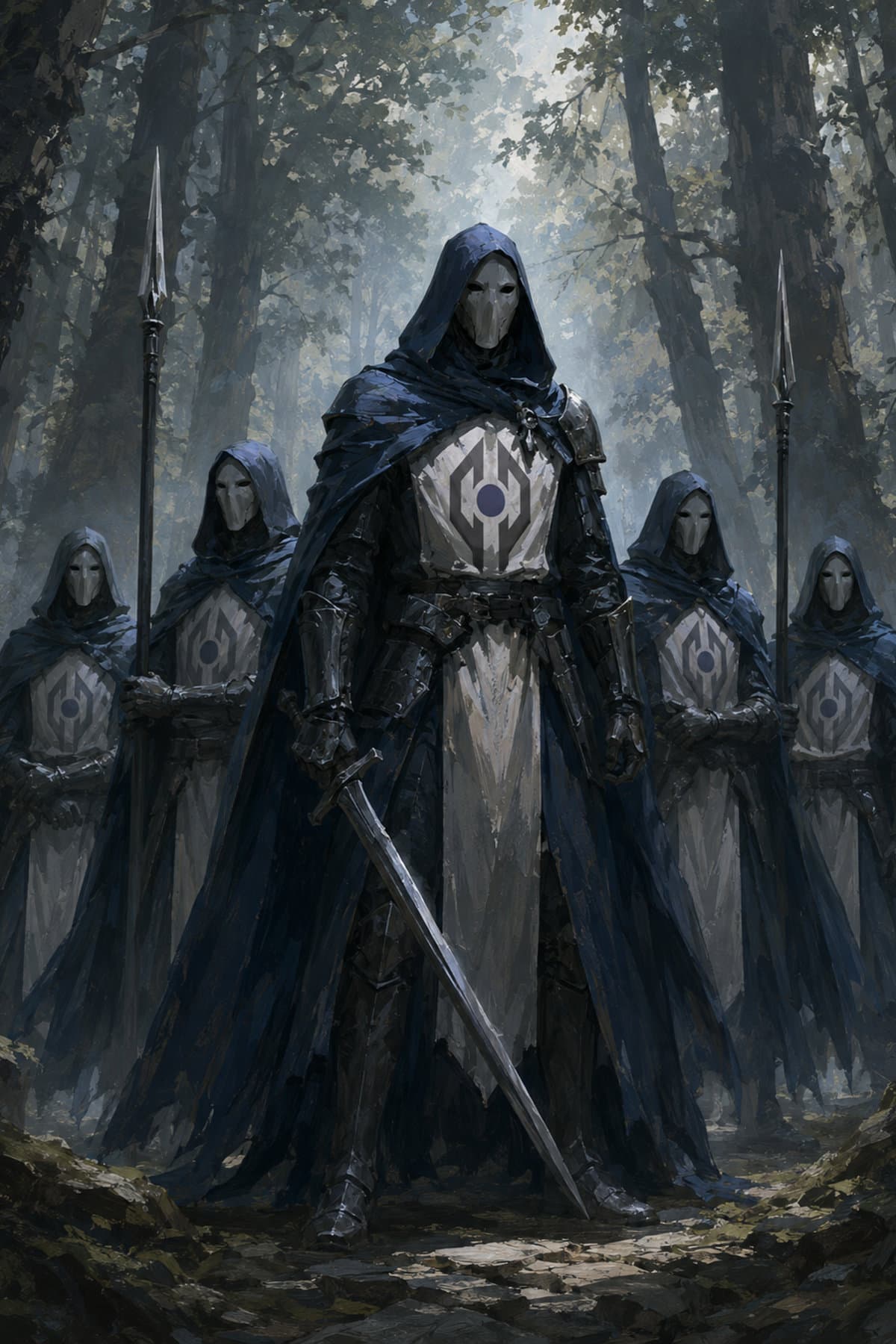

Aurent Order
The Veilbreakers

The Order of the Veilbreakers is among the most feared of the Aurents. Where other Orders serve through rite, purification, or hidden correction, the Veilbreakers serve through removal, treating Veil instability, Echo influence, and the Hollowborn as breaches to be contained, severed, or erased.
“You hear whispers. You see flickers. You call that power? I see a sickness. And I’ve brought the cure.”
Warden Myrrax, the Severed Eye
The Order of the Veilbreakers is not the oldest of the Aurents, but it is among the most feared. Where other Orders serve through rite, spectacle, doctrinal purification, or hidden correction, the Veilbreakers serve through removal. They do not seek to interpret anomalies. They do not negotiate with instability. They do not attempt reconciliation with the strange, the Echo-burdened, or the half-broken edges of the world. They erase. Their purpose is not to understand the wound in the Weave, but to cut away everything through which the wound continues to speak.
The Order was formalised during the Second Resurgence of Hollowborn activity. When traditional methods of soulmark verification, local containment, and shrine-bound suppression began failing against the spread of Echo sensitivity, Veil irregularity, and unmarked survival beyond expected thresholds. Their creation marked a turning point in Aurent history. Until then, orthodoxy had still attempted, at least in theory, to distinguish between contamination, heresy, pity, and correction. The Veilbreakers represent the moment the Conclave chose to sharpen faith into a blade rather than risk further uncertainty. What could not be contained would be severed. What could not be read cleanly would be neutralised. What threatened order by its very existence would no longer be permitted to persist.
Veilbreakers are trained to see the Veil as infection. They reject the mysticism embraced by the Veilbound, denounce the Hollowborn as fractured liabilities, and treat Echo sensitivity as a prelude to collapse. To them, the world was written clearly by Elara, and the Veil is nothing more than rot between her words, a fungal spread in the margins of scripture. Their motto, Nothing unclean endures, is not metaphor. It is procedure elevated into doctrine. Hesitation is corruption. Doubt is ingress. Curiosity is often treated as the first symptom of failure.
This absolute clarity is what gives them their reputation. Other Orders may still weigh fear against necessity, rite against consequence, or preservation against spectacle. The Veilbreakers do not. Their worldview is built not on discernment in the ordinary sense, but on interruption. Every anomaly neutralised, every Hollowborn silenced, every resonance collapsed, every witness made unable to repeat what they saw, is treated as a step toward what they call the Correction: a future in which the Veil no longer whispers at the edges of civilisation because every opening through which it entered has been cauterised shut.
Beliefs and Doctrine
The Veilbreakers stand at the harshest edge of Aurent orthodoxy. Where the wider Aurent creed already teaches that only the mark matters, the Veilbreakers push that belief into near-total hostility toward all ambiguity. They do not merely affirm that soulmarks reveal purpose. They insist that anything outside that revealed purpose is already suspect. To them, the Weave was not given to be contemplated, questioned, or felt into more deeply. It was given to be obeyed. A thing either belongs to the visible order or it threatens it.
For that reason, Veilbreakers treat the Hollowborn not only as doctrinal error, but as operational breach. Other Orders may still frame the unmarked in terms of purification, study, sacrament, or judicial correction. The Veilbreakers tend to strip away that language and reduce the problem to its coldest form. The Hollowborn are entry points. Pressure faults. Lives through which Echo, false memory, aberrant will, and Veil instability can gain anchor in the world. Their hostility is therefore not theatrical in the manner of the Ember Chain, nor sacramental in the way Sanctum Ash might render it. It is clinical, total, and absolute.
They extend this same logic to Echo. Where Sanctum Ash would call Echo misuse a blasphemy against the marked dead, the Veilbreakers are more likely to describe it as spread. Echo influence, to them, is less grave-profane than system-corruptive. The dead should remain in silence because every remnant left active in the world creates one more seam through which the lawful order may be thinned. This is why Veilbreakers are often deployed not only against Hollowborn enclaves or known heretics, but against sites of recurring anomaly, unresolved Echo turbulence, and shrines whose pressure has shifted in ways too subtle for other Orders to explain but too dangerous for the Veilbreakers to ignore.
Their doctrine is therefore defined by hostility to permeability. Veil sensitivity is not a gift. It is risk. Mystical openness is not depth. It is vulnerability. The world is safest, in their view, when all seams are shut, all excess resonance flattened, and all questionable lives removed from the chain of contagion. This makes the Veilbreakers one of the purest expressions of the Aurent instinct to answer fear with structure. It also makes them one of the most dehumanised Orders, because structure pursued without ambiguity eventually begins to hate the living for being difficult to reduce.
Relations and Conflicts
The Veilbreakers are sanctioned by the wider Aurent structure, but they are not loved within it. Sanctum Ash calls them spiritually blunted. Ember Chain dismisses them as cold instruments in place of true zeal. Whisperbrand uses them when necessary and trusts them no further than function requires. Even the Mourning Flame, which despises all Aurent Orders, reserves a special scorn for them, calling them empty shells that have mistaken numbness for purity. Yet no Order challenges them outright, because doing so would mean inheriting the tasks no one else wishes to bear. When a shrine wall begins to whisper, when an Echo anomaly writes backward prayers into stone, when a Hollowborn enclave becomes impossible to classify cleanly, the Veilbreakers are the ones summoned.
Their relationship with the Veilbound Circle is one of direct ideological hatred. Where the Circle seeks to preserve, interpret, and sometimes learn from the threshold spaces of the world, the Veilbreakers see only contamination. Veilwarding rites, hidden sanctums, Hollowborn corridors, memory relic routes, all of these are treated as pathologies to be collapsed. To the Veilbound, the Order is proof that fear of the unknown can become its own theology. To the Veilbreakers, the Circle is the disease speaking in philosophy.
With the Mourning Flame, the conflict is even more absolute. The Flame welcomes rupture, sanctifies immolation, and courts Living Echo fusion. The Veilbreakers are built to terminate exactly that sort of world. There can be no meaningful exchange between the two, only eradication. The Flame sees the Veilbreakers as hollowed instruments of denial. The Veilbreakers see the Flame as proof that hesitation in earlier purges already cost the kingdom too much.
With the Hollowborn, the relationship is singularly bleak. Other Orders may still split between capture, purification, or interrogation depending on circumstance. The Veilbreakers rarely indulge moral nuance. The unmarked are classified first as breach, second as threat, and only distantly as person. If they are taken alive, it is because some utility remains in controlled observation. If not, elimination is considered cleaner and safer. This makes the Order one of the most feared Aurent faces in Hollowborn memory.
Curiously, their standing among frontier settlements is more complex. Places ravaged by real Veil pressure, Echo-burdened deaths, or persistent anomalies may call for Veilbreakers with something close to desperate faith. These communities often know little of the Order’s deeper rites, and still less of its newer internal severances. They know only that when the walls whisper, or when a loved one begins speaking in a dead voice, someone must come who can make the wrongness stop. This gives the Order a form of grim legitimacy even outside Aurent structures. They are hated most clearly by those who know what they are. They are needed most often by those who know only what they can do.
On the Order in the Present Age
The Order of the Veilbreakers is one of the clearest expressions of what Arynbel becomes when fear of uncertainty hardens into sacred procedure.
They exist because the world no longer behaves as doctrine promised. They endure because no other Aurent Order is willing to go so far in the work of severance. Their methods are brutal, dehumanising, and spiritually suspect even to some of their allies. Yet every time the kingdom produces another site of whispering stone, another shrine gone thin, another Hollowborn manifestation no one can interpret without trembling, the logic that created the Veilbreakers appears vindicated to those already desperate for something cold enough not to hesitate.
That is their true danger.
They are not merely an Order of hunters and nullifiers. They are the institutional promise that the world’s complexity can be cured by cutting enough of it away. In an age of fraying soulmarks, rising Hollowborn births, spreading Echo anomalies, and unstable silence, that promise becomes persuasive far too easily. In recent years, as the Order has hardened further, that promise has only grown colder.
To some, they are absence, armed and sanctified.
To others, they are the last wall between Arynbel and the things whispering at its edge.
Both views are true enough to keep the Order feared.
Archive Filing
Second Vault Registry
Aurent Order Record / Veilbreakers
V2-FAC-VEI-001

Selected Archive Images
Gallery