
Path of the Thorn
The Thorn
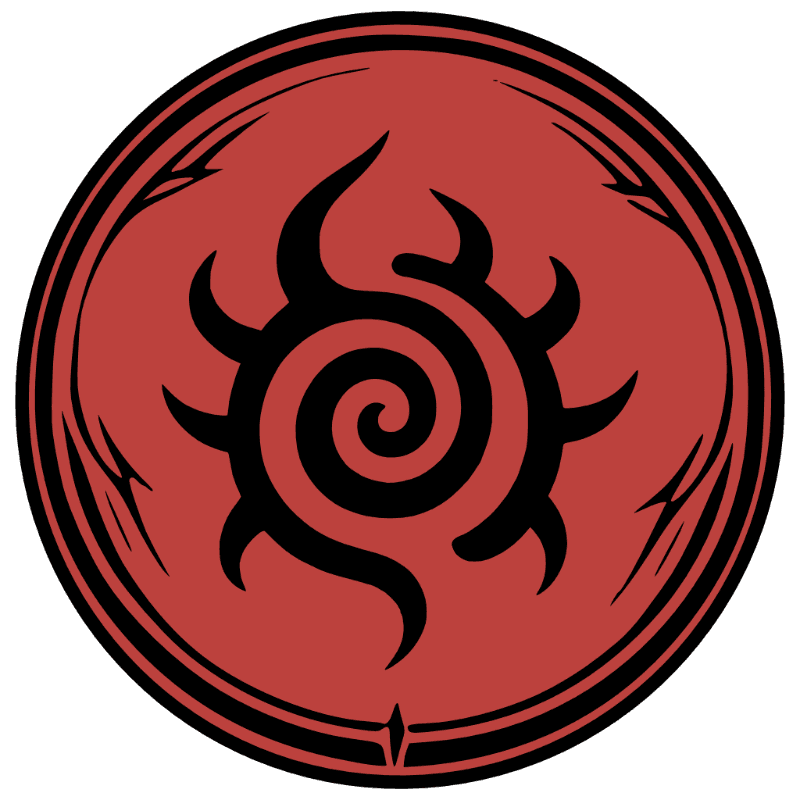
The Thorn is the Path of secrecy, caution, and survival. Its bearers are highly attentive to danger, exposure, and the subtle changes that reveal when a place or person can no longer be trusted.
“Not all threats fall to the sword. Some must be felt before they are found.”
Early Conclave commentary
Marked Form & Visible Signs
The Thorn mark is composed of barbed curls, tightening spirals, and hooked lines that seem to coil inward before threatening to strike outward again. Unlike the open arcs of the Flame or the branching fractures of the Veil, the Thorn’s geometry is compact, guarded, and difficult to read at a glance. Each curve terminates in subtle points rather than clean ends, suggesting briars, hooks, or coiled bramble under tension. Its design often resembles a thorn-wrapped spiral or a bramble vine drawn in deliberate restraint, layered in an asymmetry that implies concealment rather than display. Even when fully visible, the mark rarely feels like it wants to be seen.
Temple readers have long noted that the Thorn is one of the most misunderstood Paths in visible form. Its compactness is often mistaken for secrecy with malicious intent, yet orthodox commentary more carefully describes it as a geometry of held response. Where the Blade advances and the Crown settles, the Thorn waits. Its inward coiling is interpreted as readiness preserved, not aggression declared. The barbed terminations suggest that what is protected may wound only when pressed. In this sense, the mark’s form expresses not open violence, but defensive nearness to it.
The most common placements are along the lower back, ribcage, flank, or beneath the shoulder blade, all areas naturally concealed by clothing, cloaks, armour, or ordinary posture. When borne along the ribcage, the barbed lines often follow the curve of bone, tightening toward the sternum without ever fully reaching it, as if guarding the vulnerable interior without exposing itself to the front. When centred across the lower back, the spiral tends to rest near the spine, protecting what many glyph-readers call the body’s hidden axis. Beneath the shoulder blade, the mark frequently appears as a coiled brace of barbed curls, half-visible only when the bearer turns or reaches. Rarely does the Thorn manifest in openly visible positions. Scholars repeatedly note that the mark appears where concealment is most natural, reinforcing the long-standing belief that the Path is meant to guard through obscurity rather than presence.
In daylight, the Thorn mark appears as deepened lines of healed scar tissue with a faint red-brown undertone, as though old ink or dried blood had settled beneath the skin and refused to fade entirely. Its texture is often slightly more pronounced than that of softer Paths, though not raised enough to announce itself unless touched or closely examined. Under moonlight, it ignites in deep crimson, rust-brown, or muted wine-dark radiance. Unlike the bright severity of the Blade or the warm emanation of the Flame, the Thorn’s glow is dense and close-kept. It seems to cling to the skin rather than cast outward, swallowing much of its own light. Witnesses sometimes describe it as the glow of banked coals beneath ash or blood-dark light trapped beneath glass.
Because the Thorn is so often concealed, questions of authenticity have historically mattered greatly in both public suspicion and covert use. Forged Thorn marks are common due to their comparatively compact geometry and the fact that many who imitate them do not expect close inspection. Yet under moonlight, imitations often lack the depth and inward tension of true resonance. The crimson light appears flat rather than layered, the spiral fails to feel coiled, and the barbed tips do not seem to draw the eye inward with the same quiet pressure. A true Thorn does not merely glow. It gathers. A false one only shows itself. In Arynbel, that distinction has often meant the difference between quiet passage and exposure.
Core Nature
The Thorn mark is not a mark of malice. It is a mark of caution. From early childhood, Thorn-marked individuals often display heightened environmental awareness and a striking instinct for managing exposure. They notice who is listening before they speak. They measure distance to exits without seeming to look. They shift posture subtly to avoid open attention and often develop the habit of revealing only as much intention as the moment requires. To those who do not understand the Path, this can resemble deceit. More often, it is simply adaptive intelligence honed before the child even has language for it.
The Thorn tends to foster survival-minded perception. Its bearers often read rooms quickly, register unspoken tensions, and anticipate changes in mood or danger before others do. They are often skilled at moving through crowded spaces without drawing notice, watching before acting, and preserving options until certainty becomes possible. In unstable environments, such instincts are invaluable. A Thorn-marked person may sense that something is wrong long before it becomes obvious, not through mystical revelation, but through fine attention to what has shifted at the edge of behaviour. For this reason, the Path often produces exceptional scouts, guides, confidants, trackers, and those who can survive systems not built to welcome them.
Contrary to common suspicion, many Thorn-marked individuals are kind by temperament. Their caution is rarely cruelty. It is often the result of moving through a world that mistrusts visible ambiguity and punishes people who cannot afford to expose themselves carelessly. The Path is marked more by quiet endurance than by inherent harshness. Many Thorn bearers are deeply loyal once trust is established, though they seldom grant that trust quickly or without reason. They often protect others through foresight, discretion, and unacknowledged labour rather than open declarations of care.
Yet social mistrust has consequences. When a society repeatedly treats caution as duplicity, many Thorn-marked people are pushed into roles where secrecy becomes not just habit, but livelihood. Some become shadow-wardens, covert couriers, informants, or investigators. Others fall into smuggling, theft, assassination, or information trade because these are the only spaces where their natural gifts are valued rather than feared. The Path itself does not demand darkness. It adapts to it. That is one of the reasons it troubles rigid institutions so deeply.
Divine Purpose
Orthodox doctrine describes the Thorn as the guardian of boundaries through subtlety rather than force. If the Blade defends openly and the Flame purifies visibly, the Thorn protects by remaining unseen until pressure makes action necessary. Temple commentary suggests that Elara etched this Path so that danger could be noticed, tracked, and answered before it spread into open harm. In this interpretation, the Thorn is neither passive nor deceptive by nature. It is vigilance, given quiet form.
A lesser-cited but persistent line from an early Conclave commentary states: Not all threats fall to the sword. Some must be felt before they are found. This passage is often used by scholars attempting to reclaim the Thorn from centuries of cultural suspicion. It frames the Path not as one of intrigue for its own sake, but as a spiritual discipline of threshold attention. The Thorn moves between structures, along edges, behind declarations, and beneath surfaces. It notices where rot begins before the room smells it. It senses weakness in barriers before they collapse. Its task is not spectacle. Its task is interception through awareness.
This subtlety is precisely what makes the Path difficult for hierarchical doctrine to celebrate openly. The Crown can be displayed. The Blade can be marshalled. The Flame can be ritualised. The Thorn exists in ambiguity, and ambiguity unsettles any institution that depends upon clean visibility and declared role. As a result, the Thorn’s divine purpose is often affirmed in formal language but undermined in practical culture. It is praised in theory as necessary hidden vigilance and distrusted in reality as a mark too comfortable in shadow.
Even so, orthodox theology does preserve a place for it. The Thorn exists because not all corruption arrives at the gate. Some of it passes quietly through the hedge, grows under the eaves, or settles in the fold where no sword was drawn because no threat seemed visible yet. In that sense, the Thorn is not secondary to the Blade. It is protective in a different register. Where others hold the line, the Thorn watches what slips beneath it.
Social Role in Arynbel
Few Paths suffer greater social mistrust than the Thorn. Across large parts of Arynbel, openly Thorn-marked travellers have historically faced extra scrutiny at borders, suspicion in marketplaces, and refusal of lodging or guild welcome unless vouched for by someone already trusted. Some regions require additional registry verification before Thorn bearers can obtain trade permits, temple clearance, or sanctioned service within civic structures. The mark’s association with secrecy has made many people treat its bearers as potential threats before any action has been taken at all.
This mistrust has had lasting structural consequences. During the early Glyph Wars, a significant number of forged soulmarks were created by Thorn-marked citizens seeking relief from social narrowing under more publicly acceptable Paths. Many of these forgeries were pragmatic rather than devotional, intended only to pass cursory inspection long enough to secure work, marriage, travel rights, or safety. Their existence reveals how deeply the Thorn could limit a life, before the character had any chance to speak for itself. Arynbel often claims to revere all sanctioned Paths, yet its treatment of the Thorn has rarely matched that claim.
Within Aurent structures, however, the Path is highly valued. Aurent scouts are overwhelmingly Thorn-marked, trained to disappear into terrain, crowd, and silence with such thoroughness that only other Thorn bearers reliably sense their presence before direct reveal. The Order of the Whisperbrand draws heavily from Thorn-marked operatives, whose work in surveillance, infiltration, interrogation, and information extraction depends upon the Path’s innate subtlety and adaptive awareness. In these contexts, the very qualities feared by common society are treated as indispensable to order. The contradiction is obvious and longstanding. Arynbel distrusts the Thorn until it needs the Thorn badly enough to claim it.
Outside Aurent discipline, Thorn-marked individuals often find themselves drawn into underground networks, covert courier routes, smuggling lines, protective circles for the persecuted, or information markets where discretion is currency. Whether this reflects divine intention or simple social narrowing remains debated. What is clear is that the Path repeatedly appears wherever survival depends on moving through hostile structures without being consumed by them. In this way, the Thorn’s social role is as much a product of society’s fear as it is of the mark itself.
Cultural Perception & Superstition
Among common folk, the Thorn is associated less with open terror than with sustained unease. It is the Path people mention after lowering their voices and checking who else is near. Unlike the Blade, which can be admired from a distance, or the Flame, which can be loved and feared at once, the Thorn tends to evoke suspicion first and understanding only later, if at all. People often assume a Thorn-marked stranger knows more than they should and intends to use that knowledge when no one is ready.
Several sayings persist across regions. A Thorn at your back means eyes you cannot see. Trust a Root to feed you. Trust a Blade to guard you. Trust a Thorn only if you must. Where bramble grows, something hides. These proverbs reveal a cultural habit of associating concealment with threat rather than with survival. The Thorn is imagined not as guardian of thresholds, but as proof that something withheld must be dangerous. That assumption has shaped generations of behaviour around the Path, especially in rural and tightly doctrinal communities.
Children are sometimes warned not to stare at Thorn-marked travellers too long, lest they remember your face forever. In some cities, it is considered ill fortune for a Thorn bearer to attend a public oath ceremony, on the theory that secrecy and declared transparency cannot share the same sanctified air without conflict. Other customs are more private and less hostile. Certain families quietly hang bramble charms near back doors when travelling kin return, believing the Thorn’s nearness helps notice danger approaching from the route others do not watch. Even distrust occasionally leaves room for reluctant respect.
A darker superstition persists that if a Thorn mark ever blooms outward beyond its original spiral, the bearer has crossed some line they cannot return from. Official doctrine does not recognise such a phenomenon, yet the rumour remains stubborn. It speaks to a widespread fear that those who spend too long moving in secrecy will eventually become shaped by it beyond recall. Whether true or not, the belief reveals something important about Arynbel: it does not only fear what the Thorn can do. It fears what hidden endurance might become if pushed too far.
Mark Behaviour & Evolution
The Thorn mark remains subtle in most circumstances. Unlike the Blade, which flares at the edge of action, or the Flame, which brightens with emotion and invocation, the Thorn tends to deepen rather than blaze. Its glow intensifies during heightened awareness, stealth movement, environmental scanning, or moments when the bearer becomes quietly certain that something in the surroundings has shifted. Under moonlight, the spiral may appear tighter, its barbs more defined, and its inward pull more pronounced. The response is rarely dramatic. It is precise, close-kept, and often visible only to those already paying attention.
Over long periods of covert service or repeated survival under strain, some Thorn marks develop minor extensions around the original centre. Additional curls may form, barbs may lengthen subtly, or the innermost spiral may seem to gain depth and layering not present in youth. Scholars dispute whether these changes indicate growth in perception, accumulated environmental strain, or the body’s adaptation to a life repeatedly lived in guarded tension. Unlike more openly reactive Paths, the Thorn does not usually evolve through spectacle. It accrues. Its history gathers inward.
Many bearers report that the mark feels most present not during obvious threat, but in the moments before exposure. A room turning wrong. A crowd becoming too still. A trail losing a sound it should have kept. In such moments, the glow often remains faint while the sensation deepens: a tightness in the ribs, a pull near the spine, or the feeling that the mark has coiled more closely against the body. This makes the Thorn one of the most difficult Paths to study through public observation alone, as much of its behaviour is felt privately before it is ever seen.
Forged Thorn marks are common because their compact geometry is easy to hide and easier to counterfeit than the deeper structures of the Crown or Veil. Yet under moonlight, imitations often betray themselves through shallowness. The crimson light appears flat, the spiral lacks inward depth, and the barbs do not seem to gather tension before release. A true Thorn feels as though it is holding something back. A false one only imitates the lines of restraint without its pressure.
Relationship to the Hollowborn
The Thorn shares a quiet kinship with the Hollowborn. Both are mistrusted by broader society. Both are often read first as problem, uncertainty, or threat before being allowed to exist as persons. Both learn quickly that survival within rigid structures may require concealment, adaptation, and a careful management of what is revealed to power. For this reason, Thorn-marked individuals often display greater tolerance toward Hollowborn than many other Paths, not necessarily from doctrine, but from recognition.
In some regions, underground protection networks composed largely of Thorn and Hollowborn individuals have formed in response to persecution, forced registry, or Aurent scrutiny. These alliances are rarely formal and almost never acknowledged in sanctioned record, yet they recur often enough in field reports and whispered histories to suggest enduring pattern. The Thorn understands what it means to move through a world that assumes the worst when it sees only part of you. That understanding does not erase difference, but it often softens judgement.
Aurent Thorn operatives, especially within the Whisperbrand, are trained aggressively to suppress such sympathy. Emotional alignment with Hollowborn is treated as operational vulnerability, doctrinal softness, or infiltration risk. Yet even this institutional harshness suggests a deeper truth: the affinity exists strongly enough to require active correction. The Path does not naturally oppose the Hollowborn in the straightforward manner sometimes demanded of the Blade or Flame. It more often perceives them as fellow survivors inside hostile systems, even when policy insists otherwise.
Theologically, the Thorn does not stand in direct opposition to the unmarked. If anything, it recognises that survival in a hostile order often depends less on confrontation than on adaptation, silence, and knowing when not to step into the centre of the road. Where the Blade stands at the gate and the Flame at the altar, the Thorn waits in the hedge, watching the path others forgot to guard.
Archive Filing
First Vault Registry
Foundational Doctrine / Soulmark Path / Thorn
V1-LOR-SMK-006